

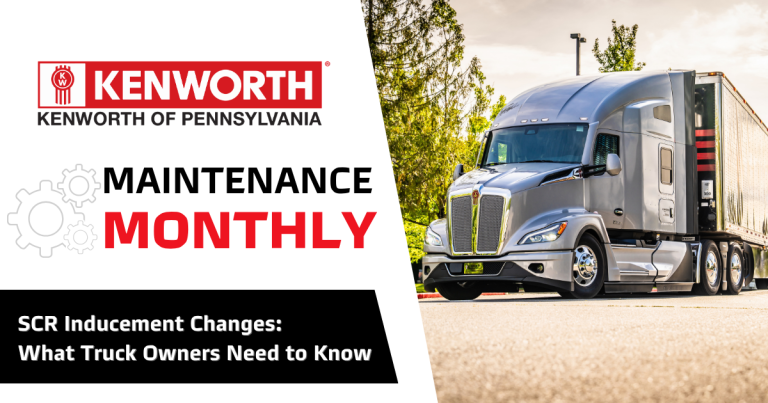
The U.S. Environmental Protection Agency (EPA) recently updated its guidance for Selective Catalytic Reduction (SCR) and Diesel Exhaust Fluid (DEF) inducement systems. In response, both Paccar and Cummins® are rolling out updated engine software and calibrations designed to give operators more time to address certain emissions system issues before the truck reaches its final speed limitation.
These changes affect different engines, model years and applications, so the exact update available for a truck depends on its engine and emissions configuration. In this edition of the Maintenance Monthly, we cover what the SCR inducement changes are, the Paccar and Cummins specific updates, and what this means for truck drivers and fleet managers.
Selective Catalytic Reduction (SCR) is an emissions control system used on modern diesel engines to reduce nitrogen oxide (NOx) emissions.
The system injects Diesel Exhaust Fluid (DEF) into the exhaust, helping convert NOx into primarily nitrogen and water before it leaves the tailpipe. If the system detects an issue, such as poor DEF quality or a component fault, the truck may enter an inducement, which can eventually limit vehicle speed until the problem is addressed.
The recent EPA guidance and manufacturer software updates change how certain of these inducement conditions are handled.
Under the updated software and calibrations, certain SCR and DEF related faults allow more time for diagnosis and repair before the truck reaches its final inducement speed.
For applicable Paccar MX-11 and MX-13 engines, the final inducement speed for certain conditions is changing from 5 mph to 25 mph. The amount of time before the final inducement speed is reached for certain component related or DEF quality issues is also increasing from 4 engine hours to 160 hours.
Cummins is making similar changes for applicable heavy-duty truck and tractor engines. Updated Cummins calibrations increase the final inducement speed from 5 mph to 25 mph for certain conditions and provide additional time before certain DEF quality and tampering related derate events.
The goal of these updates is to provide operators with additional flexibility to get the truck to a service location and have the issue properly diagnosed and repaired.
Paccar is releasing the updated software in stages based on engine model year and emissions configuration. Updates for applicable 2021B–2023 Paccar MX-11 and MX-13 engines became available in July 2026. For applicable 2024–2026 EPA 2024 MX-11 and MX-13 engines, Paccar initially expected the update to be available in early August before moving the expected availability to after August 28, 2026. Availability for existing trucks can vary, so truck owners should contact an authorized Kenworth dealer with the truck’s VIN to determine whether an update is available.
Moving forward, applicable trucks manufactured after July 20, 2026, will receive the updated software directly from the factory.
It is also important to understand that this software update is not mandatory. This update is not a proactive campaign and will not be covered under warranty.
Cummins is also implementing revised SCR inducement calibrations across applicable on-highway engines. The rollout is being phased in by engine platform and model year. Cummins’ published schedule includes applications using engines such as the X15, X12, PX-9, PX-7, L9, and B6.7, with some updates continuing into late 2026. You can view the full schedule for the Cummins updates by clicking here: Cummins SCR Inducement Change.
Similar to Paccar, the Cummins updates are not covered under warranty. Owners should contact their local Kenworth dealer or Cummins distributor to determine whether an applicable calibration is available for their engine.
These changes do not mean a truck can operate without DEF.
DEF is still required for the emissions system to operate properly, and low or empty DEF conditions can still trigger inducement steps. The additional time provided by the updated software and calibrations primarily applies to certain DEF quality, SCR system and related fault conditions.
Drivers should continue to monitor DEF levels and refill the tank as needed. Emissions system warnings should also be addressed promptly rather than relying on the additional time provided by the updated calibrations.
The biggest change is additional flexibility when certain SCR or DEF related problems occur.
Instead of certain conditions eventually limiting a truck to 5 mph, applicable updated systems will use a 25 mph final inducement speed. For certain issues, operators will also have more time to reach a repair facility before reaching that final limit.
However, these changes do not remove emissions requirements or eliminate the need to repair SCR and DEF system problems.
Please note that the schedule of updates may be subject to change. Be sure to contact your local Kenworth dealer or Cummins distributor for the latest information.
Not sure if your truck is eligible for an updated SCR inducement software or calibration? The Kenworth of Pennsylvania team can help.
If you operate a Kenworth truck with a Paccar MX-11, Paccar MX-13 or applicable Cummins engine, contact your local Kenworth of Pennsylvania service department. Our service team can help you determine whether an update is available for your truck and answer questions about the update, DEF system warnings, or other related service needs.
Make sure to have your truck’s VIN available when you call so our team can quickly check the specific engine and software information for your vehicle.
Keeping up with SCR and DEF system issues can help you avoid unexpected downtime and keep your truck operating properly. If you have questions, please do not hesitate to contact our service team.
We use essential cookies and similar technologies to operate, secure, and provide core website features. These technologies remain active because they are necessary for the website to function. With your permission, we also use optional technologies to analyze website traffic, personalize content, and support advertising.
Select Accept All to allow optional technologies, Reject All to use only those necessary for website functionality, or Customize to manage your preferences.
We use cookies to help you navigate efficiently and perform certain functions. You will find detailed information about all cookies under each consent category below.
Necessary cookies are required to enable the basic features of this site, such as providing secure log-in or adjusting your consent preferences. These cookies do not store any personally identifiable data.
Functional cookies help perform certain functionalities like sharing the content of the website on social media platforms, collecting feedback, and other third-party features.
Analytical cookies are used to understand how visitors interact with the website. These cookies help provide information on metrics such as the number of visitors, bounce rate, traffic source, etc.
Advertisement cookies are used to provide visitors with customized advertisements based on the pages you visited previously and to analyze the effectiveness of the ad campaigns.